

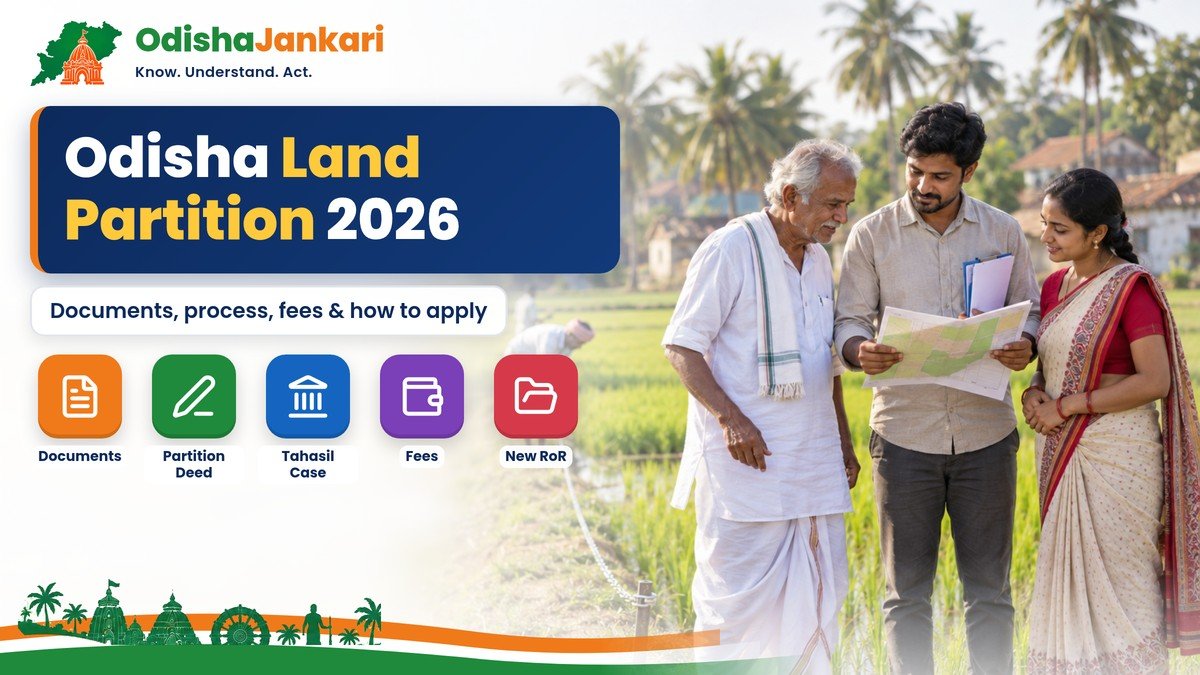
An Odisha land partition involving inherited or joint family property can cause confusion about property boundaries, legal rights, and record updates. When a Khata of land is common, each owner would not be able to sell, mortgage the land or avail of bank loans without the other owners’ consent.
This guide explains the entire legal process, application process (online/offline), necessary documents, fee structure, and updates of Record of Rights (RoR) for land partition in Odisha for 2026.
Quick Answer
- If all co-sharers agree, apply online for “Partition of Land on Mutual Agreement U/s Sec 19(1)C of OLR Act” on the Odisha Revenue Services portal. The Tahasildar decides it.
- Official fees for this route are small: ₹10 application fee, ₹80 user fee per co-sharer, ₹20 per plot demarcation fee, ₹40 per co-sharer for speed post of the RoR and ₹20 notice fee.
- The other legal routes are a registered partition deed at the Sub-Registrar (2% stamp duty and 2% registration fee as per IGR Odisha) or a partition decree from a civil court when the family does not agree.
- Keep ready: the current RoR from Bhulekh, the partition document signed by everyone, a trace map, ID proofs of all co-sharers, and death and legal heir certificates where a recorded owner has died.
- Note your Application Number. You can check progress on the portal’s Application Status page or on the DWIST (Tahasil) portal. The official time limit is 180 days.
What Is Land Partition?
Land partition is the legal division of joint ownership land among co-sharers or legal heirs into separate legal ownership (Separate Khatas).
In Odisha, partition of land involves changing of property from a Joint Khata (where several names have undivided rights to all the plots) to Individual Khatas. The co-sharer persons receive the exclusive legal title to a plot area, and an updated Record of Right (RoR/Patta) on their name in that specific demarcated plot area.
Under Section 19(1) of the Odisha Land Reforms (OLR) Act, 1960, a partition of a holding among co-sharer raiyats is valid only if it is made by one of three routes: (a) a registered instrument (partition deed), (b) a decree of a court, or (c) an order of the Revenue Officer (the Tahasildar) on mutual agreement.
When Partition Is Needed
A partition is legally required in a number of routine situations in Odisha:
- Independent bank loans: Banks are generally reluctant to accept a Joint Khata as security for a loan unless the land is partitioned or the other co-sharers give their consent.
- Selling or transferring specific parcels: A co-sharer may not sell the specific physical parcel or boundary of the land until the parcel or boundary is legally demarcated and changed into a different Khata.
- Agricultural subsidies: Government schemes (such as CM-KISAN (KALIA) and PM-KISAN) and agriculture input subsidies are linked to land records, so having your own share recorded in your name makes these applications simpler.
- Family disputes or property division: Settling current disputes between siblings or extended family concerning the division of property.
Family and Ancestral Property Considerations
| Consideration Type | Key Legal Rules & Provisions |
| Mutual Agreement Partition | Governed by Section 19(1)(c) of the OLR Act. All co-sharers must agree on the shares and boundaries. The Tahasildar can allow the partition only when every co-sharer consents. |
| Contested Partition | Regulated by the Code of Civil Procedure (CPC). When one or more of the legal heirs do not sign or challenge the apportionment of the assets, a partition suit is filed in the civil court. |
| Legal Heir Equality | Under the Hindu Succession (Amendment) Act, 2005, which applies in Odisha as in the rest of India, a daughter is a coparcener by birth and has the same rights in coparcenary (ancestral) property as a son. |
| SC/ST Land Restrictions | Section 22 of the OLR Act restricts the transfer of land of a Scheduled Tribe (ST) or Scheduled Caste (SC) raiyat to a person outside these communities without the Revenue Officer’s written permission, and Section 23 allows restoration of land transferred in breach of it. |
Documents Required for Land Partition
Compile these documents before applying online or visiting the Tahasil office:
- Current Record of Rights (RoR / Khata Patta): A new copy taken from Bhulekh Odisha.
- Partition document: The written partition agreed and signed by all co-sharers. For the deed route, this is a partition deed on stamp paper registered at the Sub-Registrar Office (IGR Odisha).
- Legal Heir Certificate: It is a certificate issued through the e-District Odisha portal to show the valid legal line of descent (no fee; 30-day time limit).
- Identity and address proofs: Aadhaar Card, PAN Card or Voter ID of all co-sharers.
- Death certificate(s): If the original recorded landowners (Pattadars) are deceased.
- Trace map / demarcation sketch: A field map clearly showing the proposed internal boundary lines and road access.
Note: The online Tahasil application asks you to upload the partition document and the trace map. If you register a deed at the Sub-Registrar, IGR Odisha has its own document list (true copy of the deed, ownership papers, photo ID, three photos of each party, PAN or Form 60, and an encumbrance certificate).
Land Partition Process: Online and Offline
Option A: Mutual Partition (Online via Revenue Portal)
- Go to the Odisha Revenue Services Portal (odisharevenueservices.nic.in).
- Click on “Apply for Partition of Land on Mutual Agreement U/s Sec 19(1)C of OLR Act”.
- Fill in the details of Tahasil, village (Mouza) and Khata number in accordance with Bhulekh records, and check the “Praja Information” shown on screen.
- Enter the details of the first co-sharer, then add the other co-sharers with the “Add more co-sharer” button.
- Upload the partition document and the trace map, and submit. Note the Application Number shown on screen.
- Pay the fees online by net banking or debit/credit card through the Odisha Treasury portal and download the Acknowledgement-cum-Payment Receipt.
- The Tahasildar verifies the documents and institutes the case; you get an SMS when the case is started. Notice is given to the co-sharers, and if a plot has to be split, a field enquiry and measurement is done before the final order.
- The Tahasildar passes the Partition Order and issues individual Khatas.
Note: Under Rule 19 of the OLR (General) Rules, 1965, the Tahasildar can allow a mutual partition only when all co-sharers consent. If there is any difference of opinion among them, the application is rejected. The order lists the plots allotted to each co-sharer and the rent and cess each will pay. Under Section 19(6) of the OLR Act, the Tahasildar sends this order for registration to the Sub-Registrar, and no registration charges are payable for it. The official step-by-step guide is here: partition procedure (PDF).
Option B: Registered Partition Deed (Sub-Registrar)
Co-sharers who all agree can also execute a partition deed and register it at the Sub-Registrar office through IGR Odisha. Online slot booking is needed to present the deed. After registration, the Registering Officer sends OLR Form No. 3 online to the Tahasildar so that a case can be started to correct the RoR. Our land registration guide explains the slot booking and deed steps, and the land mutation guide explains how the record is then updated.
Option C: Contested Partition (Offline / Civil Court)
- Engagement of a local advocate to draft a formal partition suit (plaint).
- Filing of the partition suit in the civil court that has jurisdiction.
- Service of court summons/notices on all of the non-co-operative co-sharers.
- Hearing of objections, evidence and preliminary/final decree.
- After the final decree, the court sends the list of lands allotted to each share to the Revenue Officer, and the RoR is corrected. The Revenue Inspector (RI) may be asked to measure the land in the field and make separate Khatas.
Our tip: A civil suit is general guidance only. Court fees and timelines depend on the case, so take advice from an advocate who practises revenue and civil law in your district.
Land Partition Fees and Official Charges in Odisha
The fee depends on the route you choose. These are the official charges listed in October 2026:
| Charge | Amount |
| Application fee | ₹10 |
| User fee | ₹80 per co-sharer |
| Demarcation fee | ₹20 per plot |
| Fee for speed post of RoR | ₹40 per co-sharer |
| Notice / proclamation fee | ₹20 |
Example: Two co-sharers partitioning one plot would pay ₹10 + ₹160 (user fee) + ₹20 (demarcation) + ₹80 (speed post) + ₹20 (notice) = ₹290 on the online Tahasil route.
| Deed type (IGR Odisha) | Stamp duty | Registration fee |
| Partition on equal share | 2% | 2% |
| Partition on unequal share | 2% | 2% |
| Tahasildar partition | Nil | Nil |
For a registered partition deed, IGR Odisha also lists ₹20 per plot demarcation fee, ₹40 RoR postal delivery fee, ₹80 RoR user fee per Khata and a deed postal fee of ₹60 (up to 25 pages) or ₹80 (more than 25 pages). An online slot booking fee of ₹300 per document applies (from 17 November 2025). The exact stamp duty depends on the value assessed by the Sub-Registrar, so use the IGR stamp duty calculator before you buy stamps.
Effect on RoR and Plots
After the final order is passed by the Tahasildar:
- Khata split: The parent Joint Khata gets updated and a new individual Khata is created for each owner. A new Khata gets the next number after the last one in the village, written as a fraction (for example, if the last raiyati Khata is 100, the new ones become 100/1, 100/2 and so on).
- Plot fractionation (plot numbers): When an original plot is split between owners, the part kept in the original holding keeps the old number and each new part gets the next free plot number in the village, written with the original number as a fraction (the Odisha Mutation Manual’s example: if plot 190 is split and the village’s last plot number is 305, the new part becomes 190/306).
- Bhulekh update: Once the Tahasil corrects the record, the new entries show on Bhulekh Odisha (bhulekh.ori.nic.in), where owners can view the fresh Record of Rights (Patta). For a signed copy, see our Certified RoR guide.
Tracking and Common Problems
How to Track Your Application
- Open the Application Status page on the Revenue Services portal, choose “Partition” as the application type, and enter your Application Number, mobile number and application date.
- You can also follow the case on the DWIST (Tahasil information) portal by choosing your district and Tahasil.
- If the money was deducted but no receipt appeared, wait 48 hours for the payment status to update, then generate the receipt with your Transaction ID.
Common Issues and Solutions
- Objections raised by relatives: A mutual partition before the Tahasildar needs everyone’s consent. If a co-sharer objects, the application is rejected, and the family must either settle and apply again or go to the civil court for a partition decree.
- Waiting for the field survey (Amin measurement): Go to the local Revenue Inspector (RI) office or the Tahasil with your case reference to ask when the field visit will be done.
- Order passed but Bhulekh not updated: Give a copy of the Tahasildar’s final order to the Tahasil/RI office and ask for the record to be corrected. Our guides on a pending mutation and land record correction explain where to complain.
Official Links and Helplines
| Service | Official link / contact |
| Apply for mutual partition (Sec 19(1)(c)) | odisharevenueservices.nic.in |
| Partition procedure (PDF) | Procedure to apply for partition |
| Fee structure | Revenue Services fee structure |
| Application status | Application Status page |
| Tahasil case information | DWIST portal |
| Land records (RoR) | Bhulekh Odisha |
| Partition deed registration and fees | IGR Odisha / stamp duty calculator |
| Legal heir certificate | e-District Odisha |
| Land record (Bhulekh) problems | Concerned Tahasildar, or Director, Land Records & Survey, Board of Revenue, Cuttack: dilrmp.pmu@gmail.com, 0671-2509582 (10:00 AM to 5:30 PM on working days) |
Frequently Asked Questions
What is Odisha land partition?
Odisha land partition refers to the legal sub-division of jointly owned ancestral or acquired land into separate plots and the issuance of individual land ownership records (Separate Khatas) by the Tahasil.
How can I check or apply for Odisha land partition online?
Mutual partitions can be applied for online on the Odisha Revenue Services Portal (odisharevenueservices.nic.in) under Section 19(1)(c) of the OLR Act. You can check the case’s progress on the portal’s Application Status page (choose “Partition”) or on dwistodisha.nic.in.
What documents are required?
Applicants must submit the existing Record of Rights (RoR/Patta), the partition document agreed by all co-sharers (or a registered partition deed), a Legal Heir Certificate, identity and address proof such as Aadhaar, death certificates if applicable, and a trace map (demarcation sketch).
How long does the process take?
The official ORTPS time limit for “Partition of Land on Mutual Agreement” is 180 days. Contested partition suits in civil court can take much longer due to the number of hearings and legal proceedings.
What should I do if the application or record is not showing?
In case the online record or status does not show, look out for Khata/Plot number typos and also search by Hal (current) numbers and not by Sabik (old) numbers. If your payment receipt is missing, wait 48 hours and regenerate it with the Transaction ID. Otherwise, go to the Tahasil office with your application receipt to get the status checked.
Where can I seek help if there is a problem?
For record matching issues, please visit your local Tahasil office or Revenue Inspector (RI) circle office. For Bhulekh record problems you can also write to the Director, Land Records & Survey (dilrmp.pmu@gmail.com, 0671-2509582). If the ownership of the land is in dispute, consult a civil advocate with expertise in the revenue law of Odisha.
Disclaimer: OdishaJankari is an independent information website and is not affiliated with the Government of Odisha or the Revenue & Disaster Management Department. Information is based on official sources available in October 2026. Rules, amounts and dates can change, so always confirm on the official website before applying. This article is general information, not legal advice.
Department: Revenue & Disaster Management Department, Govt of Odisha (Tahasildar)
Official Portal: Odisha Revenue Services
Information Verified: October 2026

Not sure which Odisha service you need?
Ask OdishaJankari: Describe your land record, certificate, scheme, or grievance issue.
🔒 Powered by verified OdishaJankari guidelines & official government notifications. No personal data collected.
Related Guides & Services
 Land & Property
Odisha e-Pauti 2026: How to Pay Land Revenue Online and Download Rent Receipt
Step-by-step guide to paying land revenue (khajana) online on Odisha e-Pauti in 2026: what details you need, how…
 Land & Property
Odisha Certified RoR 2026: How to Get Certified Record of Rights Online
Odisha certified RoR 2026: apply on e-District since 1 July 2026, ₹50 user fee, 3-day time limit, documents,…