

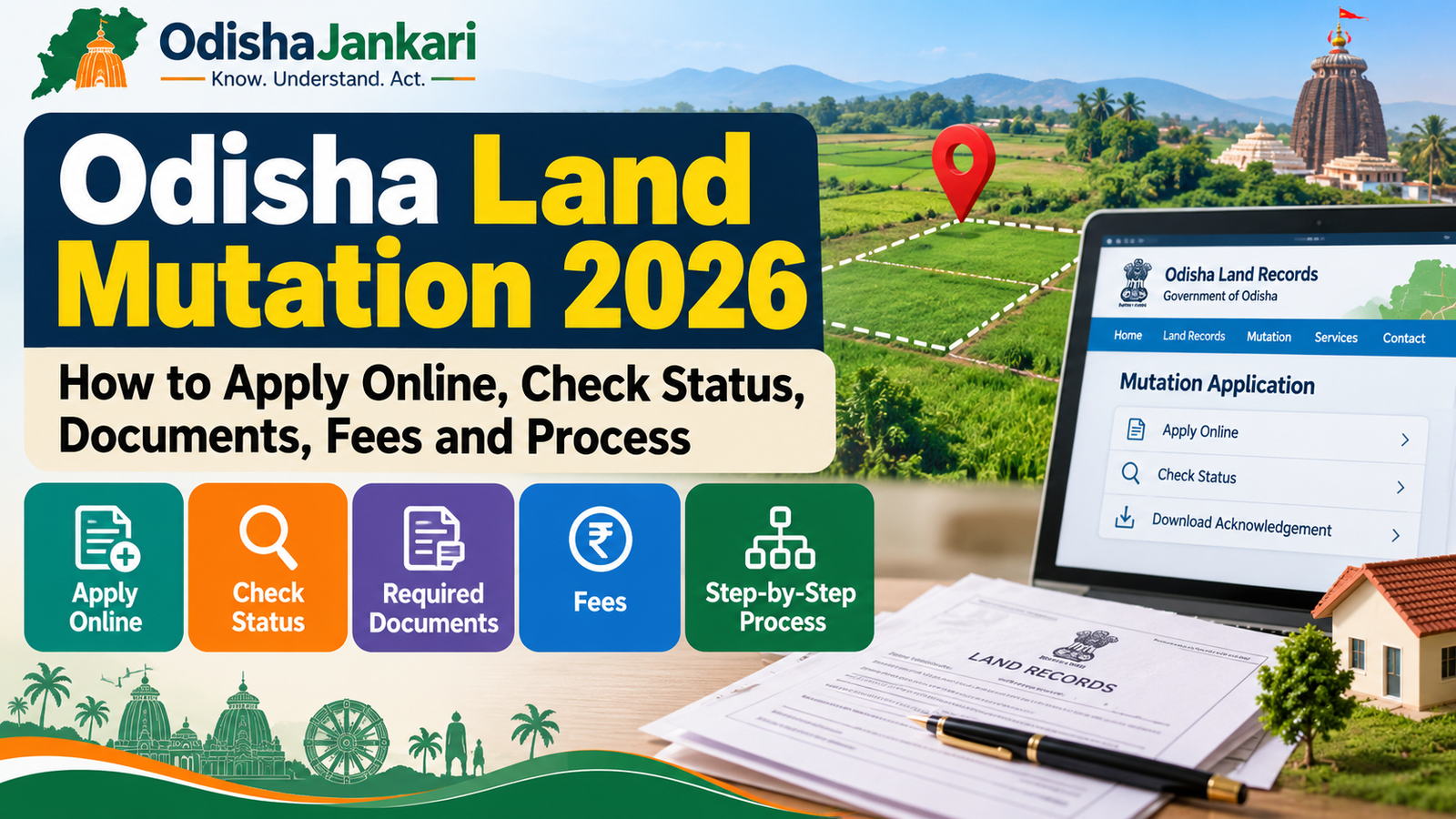
Acquiring or inheriting property is only the first step. To register yourself as the owner in the government land records, you must update the Record of Rights (RoR), commonly known as Khatiyan. This process is called Odisha land mutation.
If there is no mutation, then the state databases, such as Bhulekh, will always show the name of the previous owner or his/her ancestors. This guide explains the e-Mutation Odisha process, documentation, status and rejection.
| Access the official website here: https://odisharevenueservices.nic.in/home.aspx. |
What Is Land Mutation in Odisha?
Land mutation, also known as Namakarana or Namantarana, is the process of transferring a land-record entry from one person to another through the Revenue and Disaster Management Department. Generally, when land changes hands through purchase, inheritance, a bequest, or a court order, the revenue authorities amend the revenue records to reflect the new occupier. As a result, the updated record reflects the current landholder.
In Odisha, the Tahasil office records the mutation in the Record of Rights (RoR). After approval, the name of the new owner takes the place of the seller/deceased person in the village and RI Circle under the Khata and Plot number.
When Is Mutation Required in Odisha?
Apply when there is any change of ownership or land information. Significant trigger events are:
- Land Purchase: The purchase of land (agricultural, residential or commercial) through registered sale deeds.
- Inheritance: Passing of land to legal heirs after the death of the original landholder.
- Gift or Settlement: Transfer of ownership through a registered Gift Deed/Settlement Deed.
- Partition: Allotment of ancestral property or family property between co-sharers.
- Land Conversion: Altering the use of the land (e.g., from agricultural to non-agricultural/homestead).
- Court Orders or Decrees: Judges’ orders that establish property rights or partition.
Odisha Land Mutation Process
The Revenue Department has simplified the process into a multi-stage case disposal process.
Application
The procedure starts with the submission of a land mutation application in Odisha either from the Sub-Registrar Office (automatic e-Mutation) or from the online service portal.
Document Submission
Submit the supporting deeds, encumbrance certificate, ID proof and inheritance certificate to the Tahasil office. The office then generates a unique Odisha mutation case number that you can use to track the case.
Verification
The case is given to the local Revenue Inspector (RI). The RI verifies the land map, boundaries, possession and village records.
Revenue Officer Review
The Revenue Inspector prepares a field report and gives it to the Tehsildar. Public notices notifying objections are issued. The Tehsildar reviews the documents and reports without any objections.
Mutation Order
The Tehsildar then passes a mutation Order. Contested or rejected due to disputes or Title defects.
RoR Update
Following the completion of the Khata, the Tenant information is changed. The updated RoR can now be seen and downloaded online.
How to Apply for Land Mutation in Odisha?
An Odisha mutation online application can be made via the state’s revenue management services.
- Access the Portal: Visit the e-Services portal of the Revenue & Disaster Management Department, Government of Odisha.
- User Registration: Log in or register as a user with a user profile using your mobile number and identity credentials.
- Click on Service: Then, under the revenue services menu, choose e-Mutation.
- Fill in Property Details: District, Tahasil, RI Circle, Village. Type in the existing Khata number and Plot number.
- Fill Applicant & Deed Info: Provide information about the new Tenant(s), boundary details, and registered Deed Number, Registration Date and SRO.
- Attach supporting documents: Upload scanned PDF of all necessary supporting documents.
- Online Payment of Application Fees: Apply for and pay Application and Court Fee on the Odisha Treasury portal.
- Submit & Save Acknowledgement: Submit the application and get your Case Number to track.
Note: With e-Mutation, case generation will happen automatically for simple property purchases registered at SROs.
Documents Required for Odisha Land Mutation
Requirements for land record mutation Odisha differ from one transaction to another. Present evidence to support your argument.
For Land Purchase:
- Registered Sale Deed
- Encumbrance Certificate (EC)
- Copy of the existing RoR (Khatiyan)
- Identity and Address Proof of the buyer and seller
- Up-to-date land revenue (Khajna) payment receipt
- Affidavit
For Inheritance:
- The Original recorded landholder’s death certificate
- Official Legal Heir Certificate from the competent authority (Tehsildar)
- A copy of the original RoR (Khatiyan)
- All legal heirs’ identification proof
- Co-heir Consent Affidavit / No Objection Certificate (NOC) (If mutating in favour of co-heirs)
- Recent revenue receipt
For Gift:
- Registered Gift Deed
- Copy of the old RoR
- ID documents of Donor and Donee
- New receipts for revenue paid up to date
For Partition:
- Registered Partition Deed or Civil Court Decree
- Mutual Consent Deed
- Original RoR copy
- Proposed sketch/demarcation plan
How to Check Odisha Mutation Status Online?
The Odisha land mutation status can be checked by the applicants online:
- Go to the Odisha e-Mutation portal or land records service portal.
- Choose Track Mutation Status or Application Status.
- Select your District, Tahasil, and Village.
- Type in the Mutation Case Number or Applicant Name.
- Click on Search / Fetch Status (e.g., RI Field Report Pending, Objection Notice Issued, Approved, Rejected).
How Long Does Land Mutation Take in Odisha?
| Timeline Type | Duration | Details |
| Statutory Timeline | 30 to 45 Working Days | For uncontested cases, the Odisha Right to Public Services Act (ORTPSA) mandates it. |
| Actual Disposal Time | 45 to 90+ Days | Changes based on objections, RI workload, holidays or title disputes. |
Raising objections makes the mutation of land in Odisha a contested case and makes the process last longer.
Odisha Mutation Fees
The official cost structure for land mutation in Odisha includes:
| Fee Component | Estimated Amount |
| Application Fee | Nominal service fee (approx. ₹50 – ₹100) |
| User & Processing Charges | Convenience fees may apply to the use of the online portal. |
| Land Notice / User Charges | Normal rates of charges as prescribed by the Revenue Dept. |
Make sure you double-check the portal for the fees before actually submitting your application.
Why Is Mutation Rejected in Odisha?
Typical rejection reasons are:
- Lack of documentation: Absence of registered deeds, invalid Legal Heir Certificate or outdated revenue receipts.
- Property Title Disputes: Pending civil litigation, civil injunctions, or stay orders over the property.
- Discrepancy in Boundaries/Area: Discrepancy between area mentioned in the sale deed and the actual area on the cadastral map of the land or possession.
- Prohibited Land Transfers: If any land acquired by Tribal/Scheduled Caste and transferred without permission to non-tribal/non-scheduled caste.
- Valid Public Objections: Any legitimate objections raised by co-sharers or third parties during the notice period.
What to Do If Mutation Is Pending?
In the case of mutation status in Odisha being “pending” beyond ORTPSA timelines:
- Check Status Details: To find out which desk (RI, Dealing Assistant or Tehsildar) has the file.
- Submit Missing Documents: Check for requests for additional documents.
- Speak with the RI Circle: Speak to the Revenue Inspector to explain the field verification.
- Appeals through ORTPSA Appeals: Appeal to the Sub-Collector when it is an uncontested case and exceeds the limit.
Mutation After Father’s/Mother’s Death
After an owner’s death, land must be mutated in favour of legal heirs.
- Collect Legal Papers: Get a Death Certificate from the Tahasil and a Legal Heir Certificate from the Tahasil.
- Collect Co-Heir Consents: For joint ownership, the RoR will contain a listing of all the heirs. In the case of sole ownership, sign and file a registered relinquishment/settlement deed and/or notarise an affidavit of consent by heirs.
- Submit Application: On the online application, select “Inheritance/Succession” as the mutation type and upload the necessary inheritance credentials.
Mutation After Buying Land in Odisha
For land mutation after purchase:
- Make sure to have the land registration deed registered at the SRO.
- Apply online with registered deed information to provide if automatic e-Mutation has not occurred.
- Arrange to coordinate with the RI to check boundaries with cadastral maps.
- Collect outstanding revenue dues from the new Khatiyan.
Mutation vs Registration: What Is the Difference?
Land is not registered, and the mutation process in Odisha is different. They have different purposes:
| Parameter | Land Registration | Land Mutation |
| Primary Authority | Sub-Registrar Office (Registration Dept) | Tahasil Office (Revenue Department) |
| Core Function | Documents the deal between the buyer and seller | Checks government revenue log & tax obligations |
| Primary Document | Sale Deed / Gift Deed | Record of Rights (RoR / Khatiyan) |
| Legal Effect | Transfers contractual rights of ownership from one party to another | Records the owner as the state tenant for revenue. |
Does Mutation Prove Ownership?
No. Mutation does not give or establish a certainty of legal title. The main process of mutation is a process of revenue. It creates land revenue responsibility and presumption of possession. Absolute title is obtained through valid registered title deeds (Sale Deed, Gift Deed or Court Partition Decree).
The new RoR also confers administrative recognition and is necessary for loans, property sales, building approvals, or land acquisition compensation.
Department: Revenue & Disaster Management Department, Government of Odisha
Official Portal: Odisha Revenue Services Portal
Information Verified: September 2026

Not sure which Odisha service you need?
Ask OdishaJankari: Describe your land record, certificate, scheme, or grievance issue.
🔒 Powered by verified OdishaJankari guidelines & official government notifications. No personal data collected.
Related Guides & Services
 Land & Property
Odisha Khatiyan Number 2026: How to Find Khatiyan Number Online
Introduction If you want to check your Odisha Khatiyan number for land ownership or RoR details, you can…
 Land & Property
Odisha Land Record Search by Plot Number 2026: How to Find Land Details Online
Introduction Now, in Odisha, the checking of land records does not require several visits to the Tahsil office.…