

Introduction
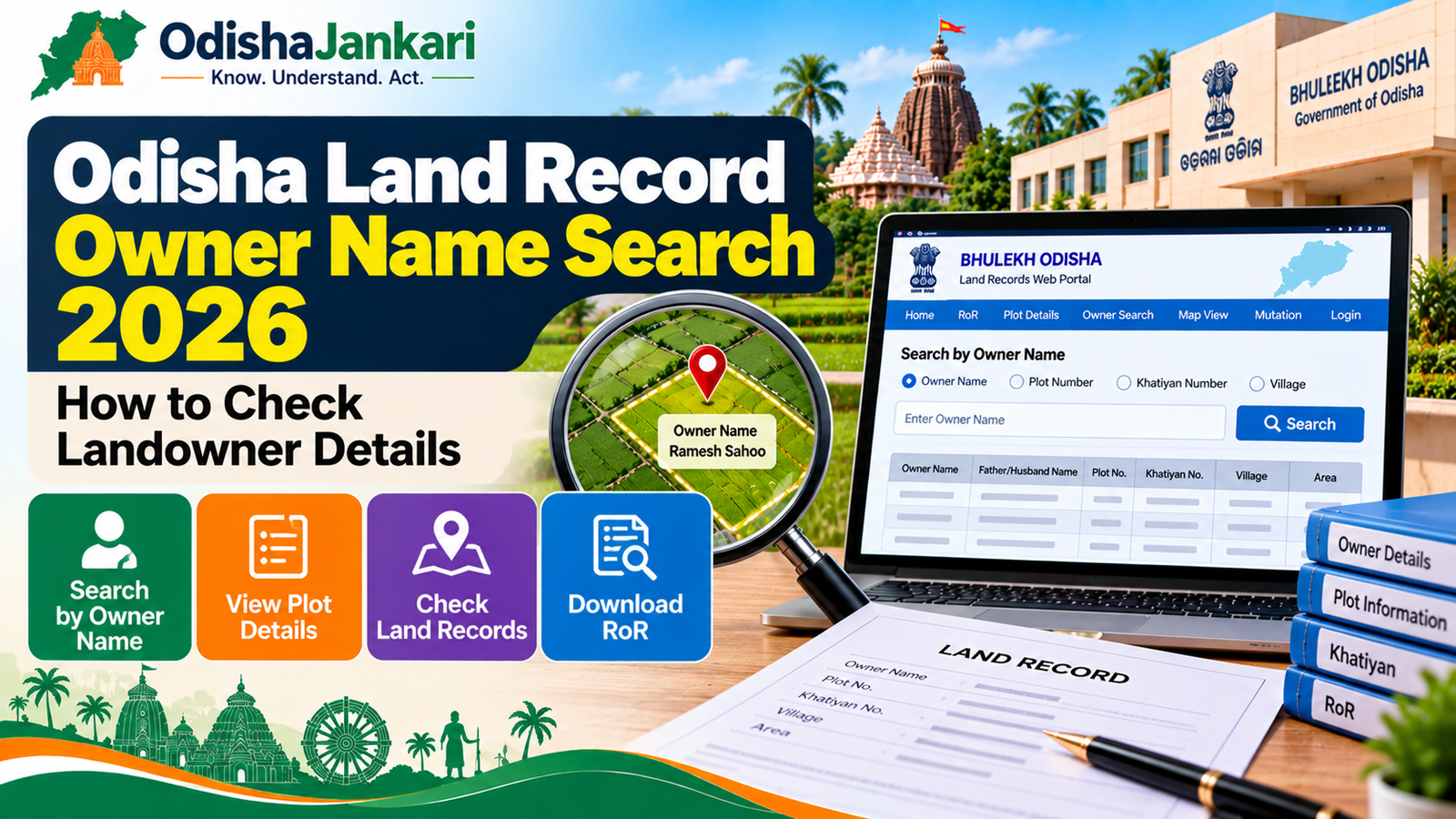
You know the village. You may even know the person. What you are lacking is the Khatiyan number or plot number; that’s the only thing that most land-record guides can’t help you with. Everybody ends up in this situation: A member of the family states the land is “in grandfather’s name”, a vendor provides you with a name and a mouza, and you want to see it for yourself prior to anything else. Odisha land record owner name search option is available but only at a specific place and after further narrowing down the village. This guide explains what you need to prepare before getting started, what this result really means, and what you can do if the name doesn’t match.
1. Can records be searched by owner name?
Yes, but under an important constraint, which you should know before you get started.
The record lookup is done at the village level in Bhulekh Odisha. After choosing one particular village, there are three options available to pull up the Record of Rights (RoR/Khatiyan):
| Search option | Use it when |
| Khatiyan | You know the holding/khata number |
| Plot | You know the individual plot (dag) number |
| Tenant | You only know the recorded holder’s name |
The word “tenant” is used by the portal to mean recorded raiyat (landholder). This is the choice to make when searching for a name.
The public does not have a facility for searching for all the names of a type of land statewide. A name search on a village that isn’t known to you is not going to work, and not any service. Don’t trust any website that uses the term ‘all-Odisha’ in their name.
2. Information needed
Prior to opening the portal, gather:
- District: One of 30 districts in Odisha.
- Tahasil: Revenue (not police station or block) under which the land comes.
- RI Circle: The Revenue Inspector circle within the Tahasil. The village drop-down will not show up until it is selected.
- Village / Mouza name: The single most important detail. Village names are repeated in different places of Odisha, so knowing the tahasil is important. The name as it appears in the record (including father’s/husband’s name if available as recorded in the RoR).
- Optional but useful: Khatiyan number, plot number, or a copy of an old patta, rent receipt or a sale deed. Keeping these documents ready can make verification easier.
No Aadhaar, no fee and no login is required to view a record. Check the relevant service details before attempting to apply online in 2026.
3. Step-by-step search
- Go to bhulekh.ori.nic.in on a desktop or Mobile Browser.
- On the home page, click on the RoR View section.
- Click on District from the drop-down.
- Select Tahasil.
- Select RI Circle.
- Select Village.
- You will see the search options; click on Tenant (not on Khatiyan or Plot).
- Select or enter the name. The portal might also have a list of the recorded holders to choose from instead of a free-text box, depending on the village.
- Click on RoR Front Page to see the record. The details of the plot are on the RoR Back Page.
- Make sure to save it as a PDF with the Print button. This gives you a useful reference when checking land records, documents, or related application status.
Practical tips: Data in the village and name fields are predominantly in the Odia script, and if text is displayed as boxes, you can download the Odia script from the portal and install it. The site is an ASP .NET application and doesn’t have the back and refresh buttons in the browser; if you hit them, it ends the session, and you’re returned to an error page. If a drop-down is not populated, then click on the previous level in that drop-down.
4. How owner/tenant details appear
The RoR is a two-page format. The following is a list of what you can expect to see:
- Front page: Khatiyan number, village, Tahasil, district and tenant/landholder’s name, name of father/husband, and address.
- Plot-wise rows: Plot number, area, land classification (kissam) and rent/revenue assessed on the plot.
- Multiple names: Joint holdings include all persons for whom a name has been recorded. If there is one name on the record, it does not imply that it is the only owner.
Read the entire record, not the first name. A fractional name is the typical situation in inherited land, particularly, and it’s the kind of information a purchaser would want to see.
5. Cross-check with RoR and plot number
The name search is only a beginning point, not the finish line. After you have a record on-screen, check it from the other direction:
- Record the name and the numbers plotted and the Khatiyan written.
- Repeat the search by plot number in the same village. A similar holder should be shown.
- Open the Bhu Naksha of that plot and match the area shown on the map with the area on the RoR. A mismatch is likely a subdivision, boundary change or a dispute that has not been resolved.
- Look at the register of deeds trail. The registration record is kept by the Inspector General of Registration at igrodisha.gov.in, and the encumbrance search will display any registered transactions against the property.
- Review pending and mutation cases. Bhulekh is connected with mutation status and also connected to the Revenue Court Case Monitoring System (RCCMS) where land disputes and cause lists are monitored.
If the RoR is for something of value, obtain an official copy at Tahasil Office; this is the one that is accepted by banks or courts without any doubt. Prices and processing times are determined locally: ask at the counter, not on a website.
6. Name spelling/mismatch issues
This is where most searches fall down, and it is very rarely a missing record, but instead a data problem.
- Transliteration: The record is in the Odia language. The name can also be spelt Sahoo/Sahu, Behera/Behara and Pradhan/Pradhana. Try each variant.
- Old names: The record might still have the name of an ancestor when the mutation has not been completed following the inheritance.
- Renumbering and splitting of the village: After boundary or settlement operations, plots get renumbered. When a plot appears to have disappeared, inquire at the Tahasil for the list of old–new correspondence.
- Use the Plot search feature instead: In most cases, the name fails, and the record is found by a plot or Khatiyan search of the same village.
- Getting it corrected: If the name is wrong or incorrect due to change of ownership, the error is corrected by mutation; if it is a clerical error, it is corrected by a correction application. Bring a deed, succession or legal heir paperwork and ID. The Tahasildar is the competent authority. Where an eligible service is available through an official portal, users should check whether they can apply online.
7. Privacy and legal-use considerations
The portal is open without any login requirement, and Odisha Land records are public revenue records. It does not necessarily mean that all uses of them are acceptable.
- Run a name search for valid reasons: for verification of your own holding, as part of due diligence prior to buying, loan documentation, inheritance, or a live dispute.
- Don’t use the portal to profile or trace individuals. You don’t use the service to compile holdings on a person you don’t have any dealings with.
- Never use a screenshot as a deed or title in a transaction. The document with standing is a certified copy; a plain download is just a reference copy.
- Beware that the information on the record, such as names, parents and addresses of third parties, should not be reproduced or shared.
Department: Revenue & Disaster Management Department, Government of Odisha
Official Portal: Bhulekh Odisha
Information Verified: 21 September 2026
Frequently Asked Questions (FAQs)
Yes. You can view and print RoR in Bhulekh Odisha without having to register.
No. If District, Tahasil, RI Circle and Village are not selected, Tenants cannot be searched.
It is the official record of rights over the land and is strong evidence, ownership being proven by reading together with the registered deed and mutation record. A certified copy is to be used for a bank or court.
Experiment with the spelling variations, then use the plot or Khatiyan number to find the same village. If it still fails, go to the Tahasil and/or local RI with the document you have.
Write a request to the Tahasil of the jurisdiction regarding Khatiyan/plot details and pay the prescribed fee. Check the existing fee and schedule at the cashier.
Your Tahasil office or Revenue Inspector for record and mutation, and the District Revenue Office for escalation.

Not sure which Odisha service you need?
Ask OdishaJankari: Describe your land record, certificate, scheme, or grievance issue.
🔒 Powered by verified OdishaJankari guidelines & official government notifications. No personal data collected.
Related Guides & Services
 Land & Property
Odisha Khatiyan Number 2026: How to Find Khatiyan Number Online
Introduction If you want to check your Odisha Khatiyan number for land ownership or RoR details, you can…
 Land & Property
Odisha Land Record Search by Plot Number 2026: How to Find Land Details Online
Introduction Now, in Odisha, the checking of land records does not require several visits to the Tahsil office.…