

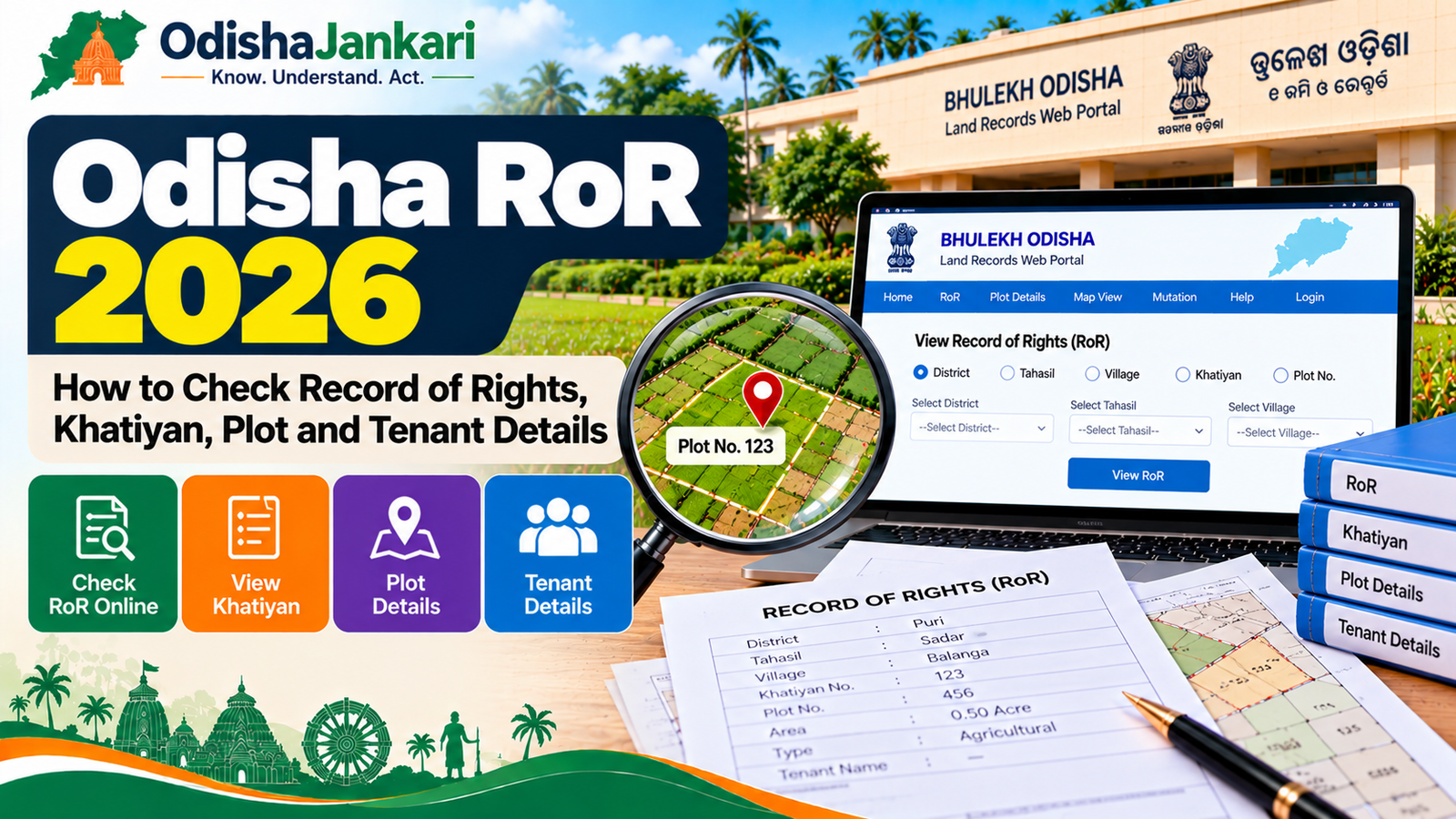
Odisha land records verification is an important aspect that needs to be done before acquiring any property, availing any agricultural loan or taking care of any family land in Odisha. These are the records that are maintained digitally on the Bhulekh Odisha portal by the Revenue and Disaster Management Department, Government of Odisha.
At the core of this system is the Odisha Record of Rights. If you want to know the boundaries of your property, want to confirm the authority of the seller or want to check the land revenue dues, then understanding how to search and read your Odisha RoR gives you instant clarity on your legal land holding in any village and Tahasil.
What Is RoR in Odisha?
The Record of Rights (RoR), locally known as Khatiyan Odisha, is the official document recorded by the revenue department that indicates the legal rights, ownership and classification for a piece of land.
An RoR is the main document that shows a snapshot of the landholding account in a particular revenue village. It connects the tenant (registered owner/right holder) with plot numbers and documents key details of the land such as area measurement, land category (Kisam), rent and relevant cess.
What Information Is Available in Odisha RoR?
The official Bhulekh system presents the Record of Rights in the following two views to give a comprehensive view of the property.
- RoR Front Page (Header & Rights Details): Administrative information such as District, Tahasil, Mouza (village) and RI Circle. It clearly states the Tenant details (owner’s name, father/husband’s name and address) recorded, rights (Rayati) and land revenue (rent, cess, and the total amount of land revenue to be paid every year).
- RoR Back Page (Plot Details): Specifics on the physical qualities of the land. It specifies all the Plot numbers associated with that particular Khatiyan, the exact area of land, the type of land (Kisam) and specific remarks or encumbrance notes added by revenue authorities.
What Is a Khatiyan Number?
A Khatiyan number (also called a Khata number) is a unique revenue-record account number for a particular revenue landholding or legal owner of a landholding in a village.
Instead of identifying physical soil, the Khatiyan identifies the administrative ledger entry. Each plot in that particular Mouza is given one central Khatiyan number if the plots are owned by a single person or a group of co-owners.
What Is a Plot Number?
Plot number (survey number) is a unique number given to a plot of land on a revenue village map.
The Khatiyan is the owner’s account, while the plot number identifies the exact geographical location on the ground. It enables Revenue Officers, Amines and Buyers to find exact boundaries, compute exact spatial area and trace specific Odisha plot record histories.
What Is the Difference Between Khatiyan and Plot Number?
| Feature | Khatiyan (Khata) Number | Plot Number |
| Definition | Administrative ledger account of a landowner. | A physical parcel identifier, which is a marker on a land map. |
| Focus | Ownership, tenant names, rights, and tax liabilities. | Geographic boundaries, classification (Kisam), precise area. |
| Relationship | A single plot number can be used in more than one Khatiyan. | Multiple plot numbers may be in a single Khatiyan. |
| Key Use | Determining who owns recorded rights on revenue records. | Identification of exact land positions and extent in land demarcation. |
How to Check RoR Odisha Online?
To check RoR Odisha online, one has to visit the official Bhulekh website in just a few minutes:
- Go to the official web portal of the Odisha government Bhulekh (bhulekh.ori.nic.in).
- On the Home page, choose your District, Tahasil, Village (Mouza), and RI Circle from the drop-down menus.
- Select the desired search criteria mode: Khatiyan, Plot or Tenant.
- Click on the item from the list or search bar.
- To see the full details of any land record, click on RoR Front Page or RoR Back Page.
How to Search RoR by Khatiyan Number?
If you have the Khata number from a past sale deed or a tax receipt, then follow these steps:
- On the Bhulekh portal, click on your District, Tahasil, Village and RI Circle.
- Click on the radio button Khatiyan.
- To search for and select your particular Khatiyan number, click on the drop-down.
- Click on RoR Front Page to find details of ownership and tenants, or RoR Back Page to find details of all the plots that are linked to the same.
How to Search Land Records by Plot Number?
Evaluating a particular piece of real estate can be easier with the help of Odisha RoR by plot number:
- Select your administrative structure (District, Tahasil, Village, RI Circle) on the online portal.
- Select the Plot radio button option.
- Choose or type in the appropriate Plot number.
- The system will show the names of tenants and the land area being occupied, along with land classification and linked Khatiyan.
How to Check Tenant Details?
If the land record is not available by the Khatiyan and plot number, then it can be retrieved by the primary holder’s name:
- Go to the RoR Bhulekh Odisha official site and select the appropriate location options (District, Tahasil, Village, RI Circle).
- Choose the Tenant search option.
- Use the scroll bar to navigate between the list of tenant names or enter the recorded person’s name.
- Click on the respective name to open the complete Odisha tenant details and related Odisha Khatiyan.
How to Get a Certified Copy of RoR in Odisha?
Web view on Bhulekh is helpful for quick reference. However, legal transactions and court proceedings require an official, digitally signed certified copy of RoR Odisha. One can get a certified copy of RoR in Odisha from the Odisha e-District portal or the Jan Seva Kendra / Common Service Centre (CSC) in their area:
- Access the Odisha e-District portal or visit a local CSC kiosk.
- Click on revenue service and then select Certified Copy of RoR.
- Enter the location details, Khatiyan number, Aadhaar/Voter ID and legal ownership reference.
- Make payments for government fees and user charges.
- Follow up on applications via online tracking; after the Tahasildar processes, you can download a digitally signed certified application.
Is Online RoR the Same as a Certified Copy?
No, there is an important difference between the two versions:
- Online RoR (Bhulekh View): It provides information and is to be used for instant online verification, property due diligence and quick look. It lacks revenue officers’ digital signatures and cannot serve as direct legal or tax evidence.
- Certified Copy of RoR: It is a document issued formally and legally by the Tahasildar on the e-District portal or Tahasil office. It is stamped, sealed and carries a valid electronic signature and can be used as proof in court, for bank loans and formal property registration.
What to Do If There Is an Error in RoR?
Formal revenue correction is necessary if the tenant name is in error, the plot size is wrong, the Kisam classification is wrong, or the tenant has no co-owner. To rectify entries:
- Find the mismatch: Match your registered sale deed, partition deed or ancestral inheritance document with the online RoR.
- File a Correction/Mutation Petition: Make a record correction/mutation petition before the local Tahasildar of the village.
- Attach Documented Proof: Attach supporting documents like registered deeds, Legal Heir certificates, old Khatiyan copies, field report sketches, etc. from Amin.
- Field Verification: Tahasildar takes the petition to the local Revenue Inspector (RI) for actual verification and making a public notice.
- Correction Order: If the Tahasildar verifies the information without any objections, he/she issues a correction order to modify the Bhulekh record.
RoR and Land Ownership: What Does It Prove?
An RoR in Indian revenue jurisprudence is a strong Odisha land ownership record prima facie evidence of possession and land revenue liability but cannot be enough to establish absolute legal title by itself.
Revenue entries are not title-denying or creating entries, the Supreme Court of India has held. The title is based on a valid title deed, for example, a registered sale deed, gift deed or court decree.
But in an updated RoR, the person recognised by the Odisha government as the recorded possessor is liable to pay land revenue. The name mentioned in the sale deed should always match the name mentioned in the Record of Rights. This ensures a smooth land transaction after purchase.
Department: Revenue and Disaster Management Department, Government of Odisha
Official Portal: Bhulekh Odisha / Odisha e-District
Information Verified: 16 September 2026
Frequently Asked Questions (FAQs)
Informational copies are available on the Bhulekh portal. To get legally valid certified copies with digital signatures, the application must be made on the Odisha e-District portal or at a local CSC centre.
In case you have lost your plot in Khata, visit the Tahasil office with the registered title deed and the old copy to submit your petition for correction or field demarcation.
When a property owner transfers ownership to another person, the owner records the transfer through a registered sale deed. The mutation deed then updates the government's official Record of Rights by replacing the seller's name with the purchaser's name in the revenue register.
For Bank Mortgages, Liabilities or Legal Quarrels, see the "Remarks" column on the RoR Back Page in Bhulekh Odisha.
The ownership rights of Stitiban land are permanent, heritable and transferable, while the Rayati land has registered tenancy rights with specific revenue rights.
The time taken for processing in the Odisha e-District portal or local CSC is approximately 3-7 working days.

Not sure which Odisha service you need?
Ask OdishaJankari: Describe your land record, certificate, scheme, or grievance issue.
🔒 Powered by verified OdishaJankari guidelines & official government notifications. No personal data collected.
Related Guides & Services
 Land & Property
Odisha Land Conversion 2026: How to Convert Agricultural Land to Non-Agricultural Use
Introduction When you are a land owner in Odisha and you want to construct a house, a shop…
 Land & Property
Odisha Land Record Owner Name Search 2026: How to Check Landowner Details
Introduction You know the village. You may even know the person. What you are lacking is the Khatiyan…